


Plastic surgery is not just the work of the surgeon, anesthesiologist and medical staff.The result of the operation largely depends on the patient himself and his behavior during the recovery period.Rehabilitation after rhinoplasty- the same part of the operation that constitutes its preparation and actual execution.
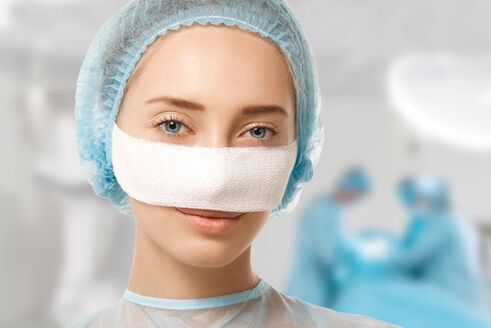
Rehabilitation after rhinoplasty: what can cause complications
Rhinoplasty is a complex operation, after which negative consequences occur in every tenth patient.Complications after rhinoplasty can be associated with both the surgeon's error and the patient's violation of restrictions after the operation.
Poor qualifications of the surgeon can lead to the formation of scars due to damage to the skin or cartilage tissue.Scars and adhesions in the future are quite difficult and long to treat.Damage to bone tissue also indicates a medical error, fraught with impaired respiratory function and an unsatisfactory cosmetic result.To correct it, it is necessary to repeat the operation, which is usually more difficult to perform, and the surgeon's skill must be at its maximum.
The consequence of violation on the part of both the surgeon and the patient is severe hemorrhage that opens during the operation.A damaged large vessel or taking drugs that affect blood clotting can lead to a similar complication.
Failure to comply with the rules of sterility leads to infection, if detected, it is important to immediately seek medical attention.Unpleasant complications such as skin necrosis occur due to over-excised surfaces.Repeated excision of damaged tissue avoids further development of tissue necrosis.
If the patient did not follow the recommendations of the postoperative period and removed the bandage prematurely or did not properly care for the nasal cavity, there is a possibility that the sutures will come off.This will require repeated surgery and stitching.Patients who do not take the doctor's recommendations seriously can cause not only dehiscence of sutures, but also dehiscence of bone and cartilaginous tissues due to the momentary desire to flaunt a new nose.
Due to a surgeon's error, various disorders are possible due to a deviated nasal septum, for example impaired nasal breathing or problems with the blood supply to the nasal passages.
Cosmetic complications caused by the surgeon's low qualifications include deformation of the nose in the area of the bridge of the nose, too short or "beak-shaped" nose, severe asymmetry and any other violation of the aesthetics of the nose.A complex consequence of medical error is the excessive removal of bone or cartilage tissue, which may require tissue augmentation through implantation, contouring, or autografting of the patient's own tissue.To avoid discrepancies between the outcome of the operation and the expected effect, it is important to undergo a preliminary simulation of the result in the clinic where you intend to perform the rhinoplasty.
Limitations after rhinoplasty
Rehabilitation after rhinoplasty involves a number of serious restrictions, strict observance of which will have a positive impact on the outcome of the operation.
Smoking is prohibited two weeks before rhinoplasty and two weeks after, as nicotine limits the access of oxygen to blood vessels and nerves and thus prevents tissue healing.Tissue necrosis develops in smokers many times more often than in patients following a healthy lifestyle.Recovery after rhinoplastyimposes a similar restriction on alcohol consumption.
A mandatory restriction is to sleep on your back with a high pillow to quickly eliminate swelling and prevent injury to the operated organ.So sleeping on the back should become a new habit for the patient.
Rehabilitation after rhinoplasty will require the patient to give up medications that thin the blood or affect blood clotting.Therefore, anticoagulants and hormonal contraceptives should not be used until the end of the recovery period.
Traumatic ball sports (basketball, football, etc.), skating, roller skating and similar transportation, including downhill skiing, should be postponed until the nasal tissues are completely healed.You should not bend over your head or engage in exercises that involve sudden lifting or changing the position of your torso.
When taking a hot shower, you should not allow the plaster cast to get wet, otherwise unpleasant complications may occur in the form of tissue suppuration or infection, and the soaked plaster will no longer be able to maintain the shape of the new nose.
The patient should not plan a pregnancy within a year after nose correction, since recovery after rhinoplasty implies complete rest of the operated organ and the absence of any stress on the body, including hormonal ones.
Stress on the body also includes physical activity, which should be excluded for rehabilitation after rhinoplasty to be successful and without complications.Any activity that causes increased pressure in the body can compromise tissue healing and proper fusion.In this regard, the recommendation not to be nervous and avoid stress in light of rehabilitation after rhinoplasty seems especially relevant, because any stress immediately affects the internal processes of the body.
Minor restrictions include a ban on cosmetics and decorative cosmetics, except for drugs prescribed by a doctor.
Rehabilitation after rhinoplasty will take place without complications if, for a month after surgery, you refrain from activities related to temperature changes, for example, you should not visit baths and saunas, it is important to avoid solariums and sunbathing, and you will also need to avoid visiting the swimming pool, as chlorinated water can have an aggressive effect on tissue healing.
The operation is completed, what next?
Patients are often worried about what awaits them immediately after surgery.The first two or three days are the most difficult and uncomfortable.A bandage will be placed on your face and your nostrils will be closed with turunda, twisted cotton swabs.Turundas fix the tissues of the nose from the inside and promote their healing in the correct position.In addition, they prevent bleeding, which is dangerous for unhealed sutures.The external fixator of the new nose is a bandage or a plaster splint.The presence of turundes in the nose significantly limits breathing, and breathing through the mouth is very unusual and quickly dehydrates the oral mucosa.In addition, the presence of postoperative swelling also interferes with normal breathing, as a result the patient may feel as if he has a cold, but the stuffy nose effect will disappear along with the swelling.This unpleasant moment must be endured for 2-3 days, after which the turundes are removed and the patient goes home.Depending on the complexity of the operation, the patient will remain in the clinic for 2-3 days with constant care and under full medical supervision.Sometimes less time will be needed in the clinic depending on the complexity of the operation.
One of the unpleasant symptoms that can occur during rehabilitation after rhinoplasty can be headaches that appear during the first few days.It can be treated with painkillers prescribed by a doctor.
The swelling of the nose already mentioned may make the patient want to clear the nose of mucus, but under no circumstances should you blow your nose or cough, as any increase in pressure in the nose can cause the stitches to come loose.For the same reason, after rhinoplasty you should not catch a cold, so as not to cause a runny nose and even more nasal congestion.After the operation, your doctor will show you how to clean your nose without the risk of hurting it.
Recovery after rhinoplasty is fraught with slight weakness and even fever in the first two days immediately after surgery.This is normal after surgery, so it's best to give yourself a chance to rest.
After surgery, hematomas and swelling under the eyes are possible, however, to hide them, it is not recommended to wear glasses for 3 months after surgery: any weight and pressure on the bridge of the nose can change the result of the operation and deform the new, not yet restored bridge of the nose.Experts recommend not being socially active and staying at home during rehabilitation.
To speed up recovery, the clinic may offer special physiotherapeutic measures.They are usually performed starting from the second day after surgery.This way, rehabilitation after rhinoplasty will be easier and more comfortable than self-care.